Cat C and Cat D are old insurance write-off categories, still seen on used-car adverts and history reports. Both described vehicles considered repairable. The distinction concerned repair cost compared with the car’s value before the incident; neither letter certifies the quality of a later repair.
For a buyer today, the useful question is what happened to this particular car, how it was repaired and what evidence supports its present condition. A lower asking price is only part of that decision.
Read the historic category, obtain the damage and repair record, arrange an independent inspection and confirm insurance before committing. Do not convert an old C or D label into a structural-damage diagnosis.
What did Cat C and Cat D mean?
| Historic label | Meaning when assigned | What it does not establish |
|---|---|---|
| Cat C | Repairable, but repair costs including VAT exceeded the pre-accident value | The exact damaged parts or today’s repair quality |
| Cat D | Repairable, with repair costs including VAT no greater than the pre-accident value, but the insurer decided not to repair | That damage was cosmetic, or that the car is safe now |
These are the definitions recorded in the Competition and Markets Authority’s 2014 motor insurance investigation, Appendix 6.3, paragraph 11. The date matters: this is historical evidence about C and D, not the current classification procedure.
For example, a modest repair bill could exceed the value of an inexpensive older car. Conversely, a larger bill could remain below the value of an expensive car. Those are illustrations of why a cost-based letter is not a reliable way to rank two vehicles by damage severity.
Are Cat C and Cat D the same as Cat S and Cat N?
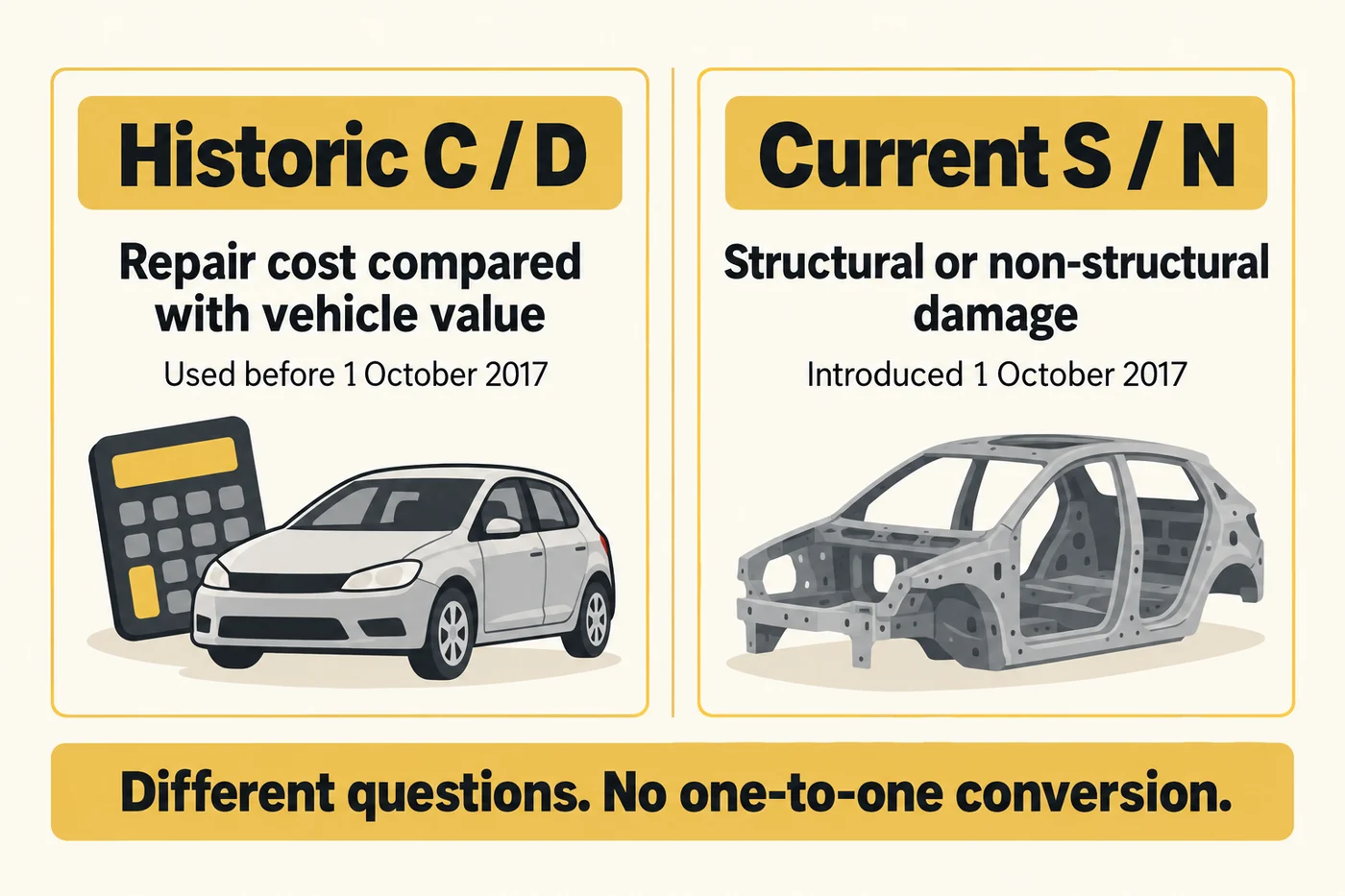
There is no dependable one-to-one conversion. The industry changed the system on 1 October 2017. Thatcham Research’s announcement describes a greater focus on vehicle condition, introducing S for repairable structural damage and N for repairable non-structural damage.
That change explains why “Cat C is now Cat S” can be misleading when read as a statement about an individual car. The old letter alone cannot tell you whether its structure was damaged. Read the original report rather than replacing the letter yourself.
For orientation, the current GOV.UK category table distinguishes the following outcomes:
| Category | Current meaning and outcome |
|---|---|
| A | Cannot be repaired; the entire vehicle must be crushed |
| B | Cannot be repaired; the body shell must be crushed, although some parts can be salvaged |
| S | Repairable structural damage; road use depends on repair to a roadworthy condition |
| N | Repairable non-structural damage; road use depends on repair to a roadworthy condition |
Repairable describes an assessment of the damaged vehicle. It does not say the necessary work has been completed. This guide concerns C and D buying decisions; an A or B vehicle should not be offered as a repaired car ready for road use.
How do you check the car’s write-off history?
Start with the registration, VIN and documents for the actual car. Ask the seller for the recorded category and incident date before travelling. Check that the VIN on the vehicle agrees with the paperwork; the DVLA VIN guidance explains the vehicle’s identity number. Our V5C guide covers what the log book does and does not establish.
Obtain a vehicle history report that explicitly includes insurance write-off records. Check its scope and date rather than assuming every free vehicle lookup includes the same information. Record the incident date and category exactly as shown, and ask the provider to explain anything that conflicts with the seller’s account.
Also use the official MOT history service to compare test dates, recorded mileage and available findings. GB car results are available from 2005 and Northern Ireland results from 2017. A gap or repeated advisory is a question for the seller, not proof of a particular accident. The write-off record and MOT record serve different purposes.
Ask for a repair evidence pack
The Department for Transport’s buying guidance recommends checking repairs, tracing who handled the vehicle and obtaining an independent expert report. Use the questions below to make that enquiry specific.
| Question to ask | Evidence to request | Follow-up if missing |
|---|---|---|
| What caused the write-off? | Original assessment and dated photographs, if available | Ask what can actually be established, rather than accepting “only a bumper” |
| Who repaired it, and when? | Repairer’s details and invoices itemising the work | Ask the seller to resolve gaps in the timeline |
| What did the repair involve? | Records identifying replaced parts and any relevant measurements, testing or calibration | Give the records to the independent inspector for interpretation |
| What has been checked since? | Written inspection findings, with date, scope and limitations | Commission your own appropriate inspection before purchase |
Send the inspector the category and available records when requesting a quote. Ask whether their inspection covers previous accident repairs, the relevant structure and systems, and what cannot be examined without dismantling. A general used-car inspection and a detailed assessment of a repaired write-off may have different scopes.
Keep the findings attached to the vehicle identity, not just to a seller’s description. If an invoice cannot be linked to this car, or the explanation changes between the advert and conversation, resolve that before paying. Use our questions to ask before viewing for the wider seller enquiry.
Does a new MOT prove the repair is good?
No. An MOT is a defined test against legal standards, not a comprehensive assessment of every repair. GOV.UK’s explanation of the test notes that it does not cover the condition of the engine, clutch or gearbox. The government’s roadworthiness guidance also makes clear that a vehicle can be unsafe despite a current MOT.
A recent pass is useful information, but it should sit alongside the repair record and an appropriate independent inspection. For the meaning of recorded defects, use our MOT advisories and failures guide. Do not treat this article, an inspection checklist or a seller’s reassurance as permission to drive a vehicle with an unresolved safety concern.
Insurance and value: check the whole purchase
Ask your intended insurer about the exact vehicle and its recorded write-off history before committing. The Department for Transport warns that some insurers do not automatically cover previous write-offs and that insurance may cost more. Obtain the actual terms, including any requested evidence, rather than assuming an online price applies.
There is no universal percentage discount that makes a Cat C or D car a good purchase. Build a small comparison using a similar car’s age, mileage, specification and condition, then record:
- The agreed purchase price and any outstanding work identified in writing.
- The cost and scope of your independent inspection.
- Your confirmed insurance quote, excess and relevant conditions.
- What repair documents you could pass to a future buyer.
A hypothetical £1,000 lower asking price leaves £400 after £200 of inspection costs and £400 of identified work. That arithmetic does not price hidden defects, future insurance differences or resale difficulty. These figures are an example, not quoted market costs or a recommendation to accept the risk.
What to do with the evidence you have
Open the situation that matches your enquiry. These are next-step prompts, not a safety score.
The seller has only an MOT and says the damage was minor
Request the original damage information and itemised repair records. Ask an independent inspector what they can verify without them. If the repair cannot be assessed adequately, pause the purchase; a low price does not fill the evidence gap.
The documents are detailed, but insurance is unclear
Give the insurer the registration and exact recorded category, and ask it to confirm acceptance and any conditions. Keep that response with the inspection and repair documents. Resolve the insurance question before committing to the car.
The advert, history report and seller disagree
Save the relevant records and ask the seller and report provider to explain the discrepancy against the VIN and incident date. Wait for a supported correction or explanation. Do not assume the most favourable version is accurate.
Do Cat C cars still need a Vehicle Identity Check?
The old Vehicle Identity Check scheme ended on 26 October 2015. Advice telling every Cat C buyer to book a VIC is out of date. That scheme concerned matching a vehicle to its identity; its closure did not remove the need for roadworthiness.
Identity problems, major alterations or missing registration documents can still require separate DVLA action. Follow the current route for the actual problem rather than relying on a historic Cat C checklist. If you continue to a viewing, take the repair questions alongside our used-car viewing checklist.
Sources checked 28 October 2026. This is a document-based buying guide; no vehicle has been inspected or approved by Motoring Desk.
The conversation