The Jaguar E-PACE is the more compact choice for a tight driveway or short parking space. The F-PACE gives you a longer cabin and more loadspace in comparable versions, but takes up noticeably more room outside. Start with the passengers, luggage and parking space you actually use; then compare the engine, equipment and history of two individual cars.

This guide is for UK buyers considering the updated E-PACE and F-PACE introduced for the 2021 model year, especially used 2021–24 cars. The numerical comparison uses Jaguar’s 2024 model-year technical sheets; it excludes the F-PACE SVR and does not apply those figures to every earlier or later derivative. Model year, registration year and engine availability are not interchangeable. This is a comparison of published specifications and buying considerations; we have not road-tested these cars.
How much bigger is the F-PACE?
| Measurement | E-PACE | F-PACE |
|---|---|---|
| Length | 4,395mm | 4,747mm |
| Width, mirrors extended | 2,088mm | 2,175mm |
| Width, mirrors folded | 1,984mm | 2,071mm |
| Kerb-to-kerb turning circle | 11.63m | 11.95m |
Source: Jaguar’s E-PACE and F-PACE 2024MY technical-data downloads. These are manufacturer reference figures from the international technical archive, not confirmation that every listed powertrain was offered in the UK. Verify a UK car’s exact specification by VIN.
The F-PACE is 352mm longer and 87mm wider with the mirrors out on this basis. That is a substantial extra length to accommodate between a garage door and a wall. The width difference is smaller, but can matter every time you pass gateposts or open a door beside another car.
Measure the narrowest part of your access route, not just the parking bay. Allow space to walk round the car, open doors and raise the tailgate. A dimension that barely fits on paper is not a comfortable daily fit. If possible, include your own driveway or a similarly tight space on an agreed test drive; check visibility and the fitted cameras rather than assuming a high trim level has every parking aid.
Which has the bigger boot?
The F-PACE has the larger published loadspace in the reference data, but its powertrain makes a meaningful difference. Use the same measurement method before comparing advertisements: a wet volume simulates filling the space with liquid; a dry figure measures solid blocks. Neither tells you whether a particular dog crate or pushchair will pass through the opening.
| Version in the technical sheet | Rear seats upright | Rear seats folded |
|---|---|---|
| E-PACE | 601 litres | 1,386 litres |
| F-PACE non-MHEV | 793 litres | 1,842 litres |
| F-PACE mild hybrid (MHEV) | 755 litres | 1,804 litres |
| F-PACE plug-in hybrid (PHEV) | 619 litres | 1,662 litres |
Jaguar’s sheets caution that boot configuration and spare-wheel fitment can change capacity. The F-PACE figures above come from its MY2024 technical sheet and loadspace footnote. Do not use the largest F-PACE figure for a P400e, or compare one of these roof-height wet figures with another car’s dry figure below a luggage cover.
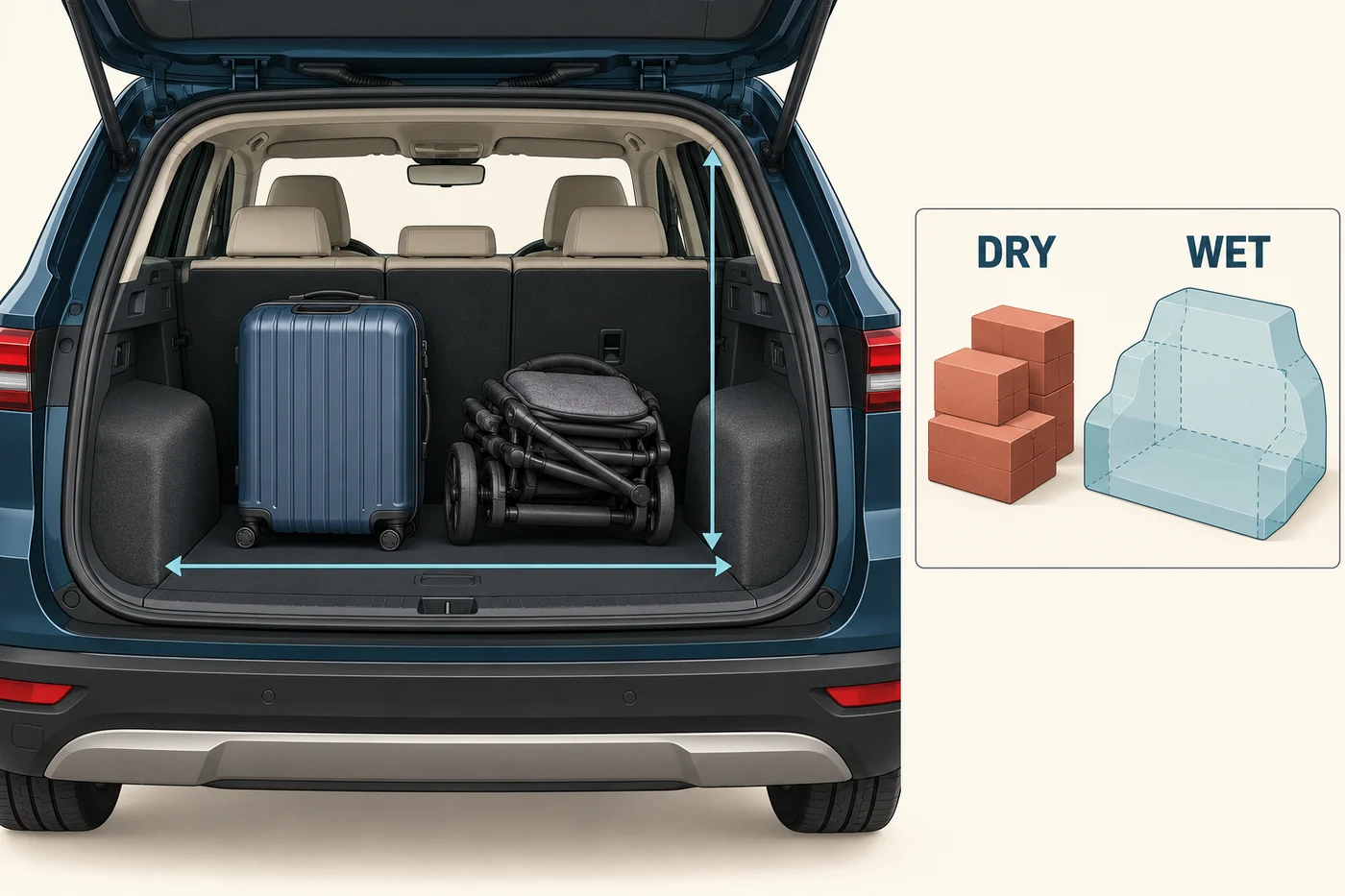
Take the awkward item to the viewing. Try it with the rear seats in the position your passengers need and with the luggage cover fitted if you normally use it. Check the narrow width between the wheelarches, the opening height, the load lip and whether the tailgate closes without pressing on the load. For a plug-in hybrid, include the charging cables in that packing test. A photograph of an empty boot can hide the compromise you will notice every weekend.
Which works better for passengers?
Both are five-seat SUVs; neither is a seven-seat alternative. The F-PACE is the stronger starting point if you regularly carry adults in the back, but sit your actual passengers in both cars. A larger exterior does not answer every headroom, entry-height or child-seat question.
- Set the driver’s seat for the person who normally drives. Leave it there while a rear passenger sits behind it.
- Check knee room, foot room under the seat, headroom and the angle of the rear backrest. Include any panoramic-roof arrangement on the car you are buying.
- If you need three people across the rear bench, test that exact arrangement. Do not judge the middle position from how spacious the two outer seats look.
- Try your child seats using the car and seat manufacturers’ instructions, and check access to buckles. Have suitability confirmed if you cannot establish the correct fit.
- Check entry and exit for anyone with limited mobility. A useful test includes opening the door in a realistic parking space.
For the wider inspection, use our used-car viewing checklist. It keeps the seating decision alongside documents, condition and the questions that remain unanswered.
Petrol, diesel or plug-in hybrid?
The E-PACE name does not mean it is an electric car. Both ranges include combustion engines, with electrification depending on the derivative. Jaguar’s updated E-PACE launch information describes the P300e plug-in hybrid with a 1.5-litre three-cylinder petrol engine; the updated F-PACE launch information describes a P400e using a 2.0-litre four-cylinder petrol engine. Later badges, outputs and battery specifications require a model-year check.
A mild hybrid is a different proposition from either plug-in model. If an advertisement just says “hybrid”, ask for the full derivative and check whether there is a charging socket. Our guide to mild, full and plug-in hybrids explains the distinction before you compare running costs.
For a plug-in hybrid, start with the charging routine
Write down where you would charge, what that electricity would cost and which regular journeys you hope to cover electrically. Then check the battery version and official range for the individual car. Treat that range as a comparison figure, not a promise for a winter commute.
Ask the seller to demonstrate charging and explain any warnings, missing cables or charging faults. Request the battery warranty terms that apply to the VIN and evidence of any relevant repairs. An estimated range on the dashboard is not an independent battery-health test. If the battery’s condition is important to the purchase, arrange a suitable professional assessment.
Check the actual drivetrain and equipment
Do not assume all E-PACEs have the same gearbox or driven wheels. The updated range included front-wheel-drive exceptions as well as all-wheel-drive versions. In contrast, the non-SVR F-PACE variants in the MY2024 reference sheet use all-wheel drive and eight-speed automatic transmissions. These facts describe those documented ranges, not every used Jaguar ever sold.
The 2021 updates introduced Pivi Pro infotainment to both models. Confirm that a car advertised as “2021” has the updated cabin and the functions you need. While parked, pair your own phone, test navigation and audio, and check the fitted parking camera, climate controls, heated seats and tailgate. Equipment, subscriptions and software can differ between otherwise similar advertisements.
Which is cheaper to own or more reliable?
The badge and size do not give a dependable answer. A cheaper E-PACE with missing maintenance evidence may be a worse purchase than a documented F-PACE, while an F-PACE needing tyres and brake work may erase an attractive asking-price difference. This guide does not rank their reliability: comparable failure-rate evidence for the exact engines, years and mileages has not been established here.
Build a first-year budget for each actual registration: purchase price, insurance quote, vehicle tax, fuel or charging, the next service and work already identified. Obtain tyre quotes for the sizes fitted, and ask a specialist to price uncertain maintenance before making an offer. Compare finance by its total payable and final payment as well as the monthly figure. Do not transplant new-car list prices or an old dealer offer into today’s used-car budget.
Ask for Jaguar’s Online Service History and supporting invoices. Compare dates and mileages with the official MOT history, follow up repeated advisories, and use the official recall check plus a Jaguar retailer’s VIN check. A recall listing is not proof that the individual car has had the work completed. An MOT pass also does not replace a pre-purchase mechanical inspection.
If your budget only works when there are no repairs, widen the shortlist before committing. Use our guide to comparing service quotes to ask for the actual work due rather than accepting “recently serviced” as a complete maintenance history.
Choose the situation that matches your shortlist
Open the relevant scenario for the checks most likely to change the decision. These are buying prompts, not a score or a recommendation about a particular car’s condition.
I mainly need an SUV that fits a tight driveway
View the E-PACE first because its smaller footprint addresses the immediate constraint. Measure mirror clearance and the room needed to open doors, then test your passengers and luggage. If it fails the load test, consider whether an F-PACE really fits your access route before accepting the extra size.
I carry adults and bulky luggage most weeks
Begin with the F-PACE, then test the exact version with your normal load. Its plug-in hybrid has a different published loadspace from the other powertrains. If you need more than five seats, move to a different type of car; neither model solves that requirement.
I am choosing between two plug-in hybrids
Write the complete engine badge, model year and battery specification beside each registration. Compare your charging access, real luggage fit, warranty evidence and any charging faults. A higher advertised mpg figure is not enough to choose the car, because how often you charge and how far you drive affect the result.
What to establish before paying a deposit
Keep a short written comparison of the two cars: the exact derivative and build specification; passenger and luggage fit; parking test; service and recall evidence; professional inspection findings; and first-year costs. Mark an unanswered item as unknown rather than giving it an optimistic score.
The E-PACE earns its place when its smaller footprint makes daily use easier and it still carries what you need. The F-PACE earns the extra space it occupies when you use its cabin and load area. In either case, choose an individual car whose condition and documents support the purchase.