An automatic is a way of operating a car, not one gearbox design. A conventional automatic changes between fixed ratios; a CVT varies its ratio continuously; a dual-clutch transmission uses two clutch-controlled gear paths. Hybrid e-CVT systems need a separate explanation. The letters beside the selector will not tell you which mechanism is fitted.

That distinction matters when an advert says only “automatic”. You might be looking at a car that changes through eight physical ratios, one that holds the engine at a steady speed while the car accelerates, or a hybrid whose electric motors are part of the transmission’s operation.
Here is how the main systems differ, what their names reveal and how to establish what is fitted to a particular car. If you are still deciding whether to learn in or buy a manual, our manual-versus-automatic guide covers that wider choice and the licence rules.
The main automatic gearbox types at a glance
| Type | How it changes the relationship between engine and road speed | What to establish |
|---|---|---|
| Conventional torque-converter automatic | Fixed gear ratios; a fluid coupling and lock-up clutch manage the connection to the engine. | The gearbox family, version and service specification—not just the number of speeds. |
| Belt or chain CVT | Variable pulleys change the working radius of a belt or chain through a continuous range. | Whether any advertised “gears” are programmed steps; whether a physical launch gear is also fitted. |
| Dual-clutch transmission, or DCT | Two clutch-controlled gear paths allow one ratio to be prepared while another is driving. | The exact unit and whether its clutches are wet or dry. DSG is Volkswagen’s familiar label. |
| Power-split hybrid e-CVT | A gearset and motor-generators manage the relationship between petrol-engine speed and wheel speed. | The hybrid architecture. An e-CVT label does not establish that a belt CVT is inside. |
| Automated manual, or AMT | Actuators operate a manual-based gearbox and clutch. | The actual transmission description; “automatic” alone may conceal this type. |
The matrix describes mechanisms, not a reliability ranking. The manufacturer examples and documents below explain the differences; they are not claims that every model from a brand uses the same transmission.
Torque-converter automatics: two separate jobs
It helps to separate connecting the engine to the transmission from selecting a gear ratio. The torque converter performs the first job. Oil transfers motion between its rotating elements, allowing a difference in speed between the engine and the transmission input. A lock-up clutch can then provide a more direct connection and reduce losses. ZF’s torque-converter explanation describes both the fluid coupling and lock-up function.
The gearbox behind it supplies the ratios. In a typical modern conventional automatic, combinations of gearsets, internal clutches and brakes provide a set of forward gears. These internal brakes hold transmission components; they are separate from the brakes at the wheels. ZF’s eight-speed 8HP example uses four gearsets, three multi-disc clutches and two brakes. Eight speeds therefore does not mean eight separate, manual-style gear pairs. See ZF’s 8HP technical description.
For the driver, this distinction explains why smooth movement away from rest and the character of an actual gear change are different things to assess. A transmission can be easy to manoeuvre yet choose a shift timing you dislike. Try normal acceleration and low-speed parking separately rather than judging it from one quick drive.
There is also a terminology trap: a torque converter is a component, not an exclusive gearbox category. Nissan’s documented Xtronic CVT uses one too. A car having a torque converter does not automatically mean it has a conventional stepped automatic. Nissan explains that combination.
What is a CVT gearbox, and how does it work?
CVT means continuously variable transmission. In a belt-type design, two pulleys alter the radius at which a metal belt runs. Changing the relative working diameters changes the ratio between input and output speeds. It can move through a continuous range rather than selecting only first, second, third and so on. Nissan’s Xtronic engineering guide illustrates the pulley movement.
“Continuously variable” does not mean an unlimited speed range. There are upper and lower mechanical limits, with ratios available between them. Nor does every CVT use a belt: Subaru describes a chain-based version of this principle in its Lineartronic technical overview.
Subaru’s UK engineering overview describes selecting ratios to keep the engine in an appropriate rev range. In practice, this means the car can gain speed without the repeated rise and fall in revs associated with upshifts. Listen during ordinary acceleration; an unfamiliar sound alone does not establish a fault.
Why some CVTs still have numbered gears or paddles
A manufacturer can programme selected ratios for a manual mode. The driver chooses a numbered step, although the underlying mechanism remains continuously variable. Subaru’s official model comparison describes Lineartronic CVTs with paddle-operated manual modes. The number shown in such a mode is not, by itself, proof of that many physical gear pairs. Subaru’s explanation is a useful example of the distinction; its model specifications apply to its US market.
There are mechanical variations as well. Toyota’s Direct Shift-CVT adds a physical launch gear to a belt-type CVT. This changes how the transmission handles starting off, and illustrates why “CVTs have no gears” is too broad. This Direct Shift-CVT is also different from Toyota’s power-split hybrid e-CVT. Toyota documents the launch-gear design.
CVT and hybrid e-CVT are not interchangeable terms
Toyota’s power-split hybrid system provides a continuously variable relationship without using the conventional CVT belt-and-pulley mechanism. A planetary gearset links the petrol engine, electric motor and generator. Managing the motor-generators allows the system to control engine operation while distributing power mechanically and electrically. Toyota explicitly distinguishes this arrangement from a belt-driven CVT in its Prius Plug-in technical explanation.
That is why a complaint, repair description or fluid recommendation for a conventional belt CVT cannot simply be transferred to a Toyota hybrid because both adverts contain “CVT”. First identify the architecture and the specific unit. The distinction explains which components are present; it does not establish a guaranteed lifespan.
Hybrid layouts also differ from one another. Honda’s documented two-motor e:HEV system can use an electric motor to drive the wheels while the engine generates electricity, then connect the engine through a lock-up clutch in engine-drive mode. It should not be assumed to be Toyota’s planetary power-split arrangement. See Honda’s e:HEV technical description.
When researching a hybrid, start with its engine and hybrid-system specification. Searching only for “CVT problems” can return discussions about a different mechanical design.
Dual-clutch transmissions: what the second clutch changes
A dual-clutch transmission divides its gears between two clutch-controlled paths. In Volkswagen’s described DSG layout, odd-numbered gears use one path and even-numbered gears the other. While one is transmitting drive, a likely next gear can be prepared on the other.
For example, when fourth gear is in use, the system can preselect third or fifth. Changing which clutch transmits drive then completes the shift. This preselection is the important idea: two clutches do not mean the car is simultaneously driving through two incompatible ratios. Volkswagen’s DSG explanation describes that sequence.
Wet and dry clutches
In a wet-clutch design, the clutch pack operates in oil; a dry-clutch design uses a different arrangement. Volkswagen documents both within the DSG family. Consequently, “DSG” or “seven-speed DSG” does not give you enough information to apply one fluid-change interval, parts list or repair history to every example. Volkswagen’s overview distinguishes the versions.
The useful ownership question is which unit this car has, followed by which instructions apply to it. During an appropriate test drive, assess parking and gentle pull-aways as well as ordinary shifts. If you notice a repeated shudder, warning or unpredictable response, get the specific car assessed; do not accept “they all do that” as a diagnosis.
Where an automated manual fits
An automated manual retains a manual-based transmission but operates the clutch and gear selection for the driver. It is a separate design to keep in mind when an inexpensive used-car advert says simply “automatic”. Hyundai’s i10 documentation provides a clear AMT example, including automatic clutch operation and a manual selection mode. See the i10 transmission description.
Its shift sequence can feel different from a DCT or a conventional automatic, so the absence of a clutch pedal is only the beginning of the comparison. Ask the seller to confirm AMT explicitly if that is what the vehicle specification says. A reassuring generic label does not replace an accurate description.
How to identify the gearbox in a particular car
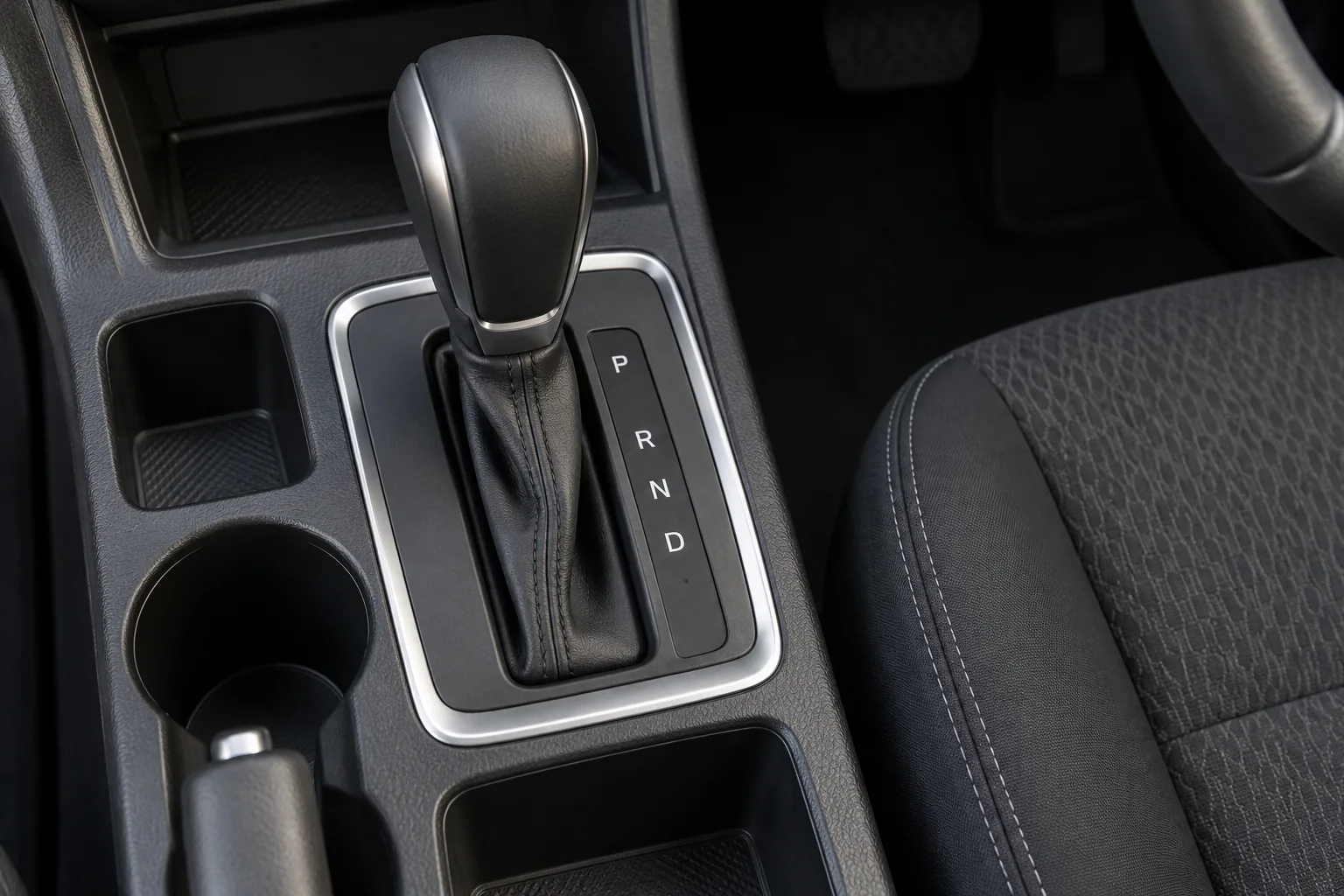
Treat identification as a short document check, not a guess based on how the gear lever looks.
- Record the exact vehicle. Note its model year, engine, power output, drivetrain and market. A familiar model name can cover several transmissions.
- Use the correct manufacturer literature. Match the specification or handbook to that version. Volkswagen, for example, provides an owner’s-manual lookup using the VIN, with retailer help for older cars.
- Resolve a vague description. If the paperwork still says only “automatic”, ask a manufacturer retailer or transmission specialist to confirm the type and relevant gearbox code against the VIN. Ask for that identification in writing.
- Match the maintenance evidence. Check invoices against that gearbox and its required work, rather than assuming that an engine-service stamp includes transmission servicing.
Keep the answer with your shortlist: “confirmed model/engine, transmission type and code, source of confirmation, servicing evidence, unresolved questions”. That record is more useful than a list of supposedly good or bad gearbox acronyms.
Decode an advert: what does the description actually prove?
Open the description closest to the one you have found. These checks help you separate useful information from assumptions.
“Eight-speed automatic with manual mode”
You have information about available ratios and driver controls, but need the exact transmission identification. Manual mode describes how the driver can request a change; it does not mean the gearbox is an automated manual. Ask for the manufacturer specification for the engine and model year.
“CVT with paddles”
Paddles can select programmed ratio steps. Do not reject the CVT description just because a display shows gear numbers. Check what the handbook says the paddles do and whether the specification identifies a conventional CVT, a hybrid system or another arrangement.
“Hybrid automatic”
This does not establish the transmission architecture. Find the exact hybrid system before applying information about another model. A power-split e-CVT, Honda’s described two-motor system and a hybrid using a stepped transmission should not be treated as mechanically identical.
“Sealed for life—no gearbox servicing needed”
Ask for the applicable written schedule and what the wording covers. ZF advises checking its relevant lubricant list, the vehicle manufacturer’s requirements and operating conditions. That is evidence against inventing one interval for all automatics, not a universal instruction to change every gearbox’s oil now. See ZF’s oil and servicing FAQ.
Once you have identified the transmission, put it back into the wider decision: whether the car fits your journeys, passengers and ownership plans. Our guide to choosing your next car provides that starting framework.
Technical sources checked on 13 October 2026. This is an explanation based on manufacturer documentation, not a first-hand road test or a transmission reliability study. Archived documents are used to explain the named mechanisms, not current model availability.
The conversation