Torque is the turning effect produced by an engine or electric motor, usually quoted in newton metres (Nm). It matters because the drivetrain converts it into a force at the tyres. But a bigger engine-torque figure does not automatically mean a faster car: engine speed, gearing, vehicle weight and grip all affect the result.

To use a torque figure when buying a car, read the rpm range beside it, then compare power, weight and the exact gearbox. That gives you a better starting point than choosing whichever brochure has the largest Nm number.
What does a newton metre mean?
Imagine pushing at right angles to a lever. A force of 10 newtons applied 0.5 metres from its pivot produces 5 Nm of torque. Apply the same force one metre from the pivot and the torque becomes 10 Nm. The longer lever increases the turning effect without increasing the force.
This is the relationship described in OpenStax’s explanation of torque: force multiplied by its perpendicular distance from the axis. In a car, that turning effect is passed through rotating shafts and gears rather than a hand-operated lever.
UK specifications may use Nm or lb ft, meaning pound-feet of torque. Using NIST’s unit conversion, 1 lb ft is approximately 1.356 Nm. So 300 Nm is about 221 lb ft. Those are two descriptions of the same torque, not two performance ratings.
Torque versus power: why rpm matters
Power measures how quickly energy is transferred. Torque describes the turning effect at a shaft; power also accounts for how fast that shaft turns. For a rotating shaft, power equals torque multiplied by angular speed.
In the units used on car specification sheets:
Power in kW ≈ torque in Nm × rpm ÷ 9,550
For illustration, 300 Nm at 2,000 rpm gives about 62.8 kW. If the engine can still produce 300 Nm at 4,000 rpm, it is producing about 125.7 kW. The torque is unchanged, but twice as much rotational work is being done each second.
Use torque and rpm from the same operating point. Multiplying a brochure’s maximum torque by the rpm quoted for maximum power is wrong unless that torque is actually available at those revs. The two peaks need not occur together.
When comparing power figures, check the units too. Mechanical horsepower, often quoted as bhp, and metric horsepower, labelled PS, are slightly different: 100 kW is approximately 134 bhp or 136 PS. A change of unit has not made the car stronger.
Read the rpm range, not just the peak
An illustrative specification of 300 Nm at 1,500–3,500 rpm means the stated maximum torque is available across that engine-speed band under the specified conditions. It does not mean the engine always produces 300 Nm there: the driver’s demand and the control system determine how much it actually delivers.
A broad torque band can make a car feel flexible because useful output is available across a wider range of revs. But the gearbox decides which engine speeds correspond to your road speed. An automatic’s shift choices also affect whether the response feels immediate or hesitant. Our guide to automatic gearbox types explains the different arrangements.
If a seller lists only a peak torque figure, ask for the manufacturer’s technical sheet for that exact engine, gearbox and model year. Do not carry specifications across different versions simply because the badge is the same.
Why engine torque and wheel torque are different
A reduction gear makes its output rotate more slowly while increasing torque. ZF describes this explicitly for its electric reduction drive. A combustion car’s gearbox and final drive provide the same kind of trade-off: gearing changes torque and speed together.
For a simplified illustration, ignore drivetrain losses and use the combined reduction through the gearbox and final drive:
| Illustrative case | Engine output | Overall reduction | Total driven-wheel torque |
|---|---|---|---|
| A | 300 Nm at 2,000 rpm | 8:1 | 2,400 Nm at 250 rpm |
| B | 200 Nm at 3,000 rpm | 12:1 | 2,400 Nm at 250 rpm |
Both cases deliver approximately 62.8 kW before losses. Case B has less engine torque, but its greater reduction produces the same total torque at the driven wheels at the same wheel speed. These are invented arithmetic examples, not specifications or measured acceleration results for real cars.
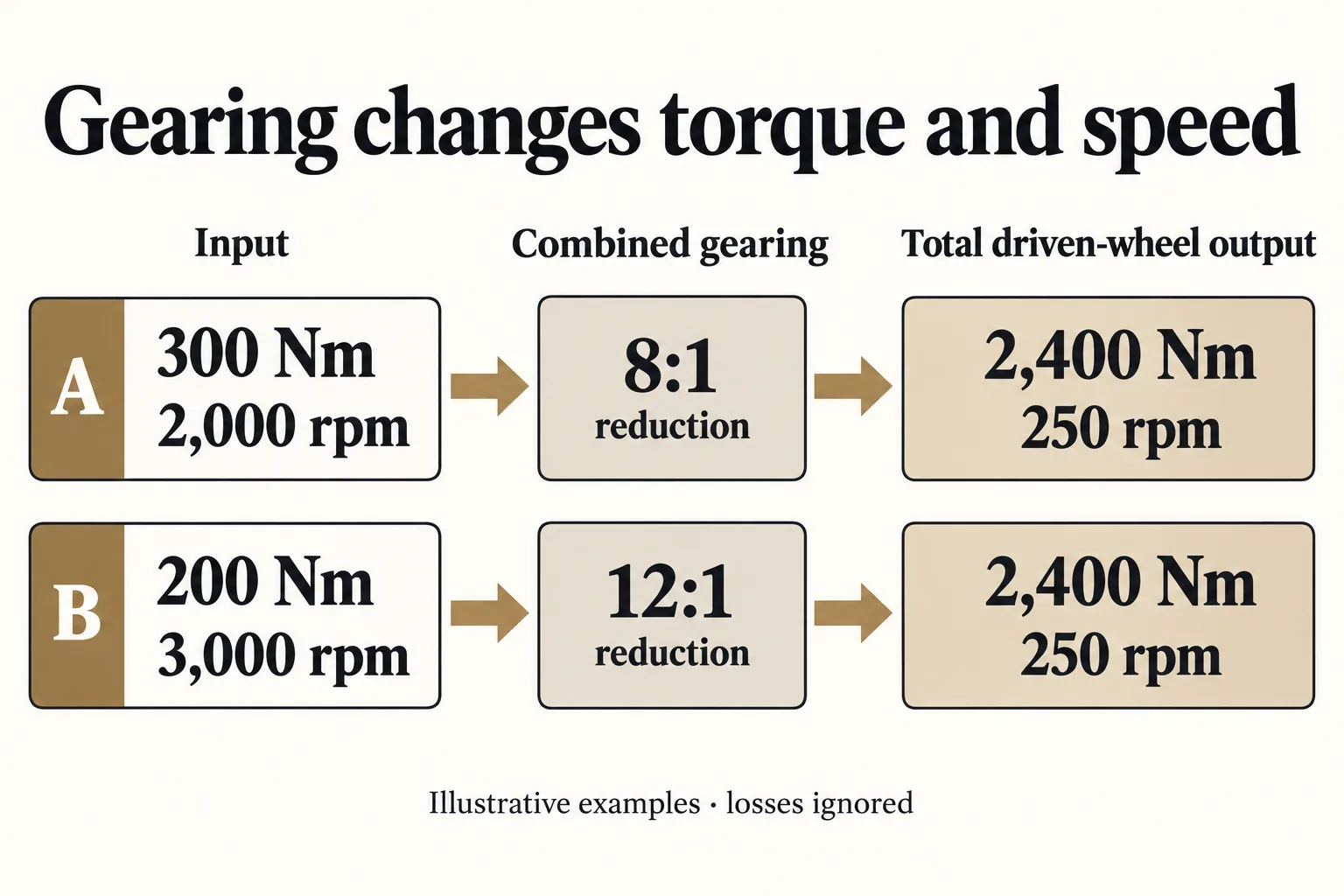
Real transmissions lose some energy, and the torque must be distributed between driven wheels. Do not compare an engine’s Nm rating with a manufacturer’s much larger axle- or wheel-torque claim as though they were measured at the same place. Gearing can increase torque; it does not create extra power.
What actually determines acceleration?
The tyres must turn wheel torque into usable force against the road. Wheel size matters to that relationship, and available grip limits how much force can be transmitted. More torque cannot help fully if the tyres cannot use it.
The car must then overcome opposing forces and accelerate its mass. Newton’s second law explains why the same net force produces less acceleration in a heavier vehicle. Passengers and luggage count towards that mass too.
Power becomes particularly useful when considering the ability to keep accelerating as speed rises. At a given non-zero road speed, tractive power equals tractive force multiplied by speed, following the force-and-speed relationship for power. The available power through the usable rev range matters more than an isolated peak. Drag, gradients, transmission behaviour and grip still influence the outcome.
A quoted 0–62 mph time is a more complete description of one acceleration test than peak torque alone. It still does not tell you exactly how responsive a car feels in ordinary driving, or compare directly with a 0–60 mph result.
Do electric cars change the rules?
An electric traction motor can produce substantial torque from very low speed. Bosch’s electric-motor documentation describes high starting torque and the role of cooling in continuous output. This helps explain an EV’s prompt initial response, but does not mean maximum torque is available at every motor speed indefinitely.
EVs also use gearing. Porsche’s technical description of the original Taycan powertrain, for example, describes a single-speed front reduction and a two-speed rear transmission. It is a documented example of gearing in an electric car, not a specification for every current Taycan version.
Read any conditions attached to a peak-output claim. Battery state and temperature can limit available performance: Volkswagen UK’s reduced-power guidance identifies low charge and temperature extremes as relevant conditions. Check the exact car’s handbook rather than assuming its headline rating is always available.
A practical way to compare two cars
| What to record | What it helps you judge |
|---|---|
| Torque and its rpm band | Where the engine can provide its strongest turning effect. |
| Power, units and rpm | Output with shaft speed taken into account; compare matching units. |
| Gearbox and vehicle weight | How output is delivered and how much mass it must move. |
| Acceleration figures and their conditions | Whole-vehicle performance over the same speed interval. |
| Your usual load and journeys | Whether the car’s response, refinement and running costs suit its actual job. |
Use the following situations to decide what evidence you still need.
One car has 300 Nm and the other has 400 Nm. Which should I choose?
Neither number settles it. Complete the comparison above, including the torque bands, gearbox and weight. On a normal, lawful test drive, assess smoothness and response in representative conditions rather than trying to reproduce an acceleration claim. There is no universal “good torque” threshold that fits every car.
I want easy everyday driving, not the fastest car
Pay attention to how readily the car responds to ordinary accelerator inputs and whether its gearbox changes gear smoothly. A useful torque band may help, but a brochure cannot describe the whole experience. Compare the exact versions you can buy, alongside the running-cost considerations in our petrol versus diesel guide.
I need to tow a caravan or trailer
A large torque figure does not establish towing permission or capacity. Start with the exact vehicle’s towing limits and permitted weights, including the loaded combination. GOV.UK explains where to find these limits. Torque can then inform your performance comparison within a suitable, compliant combination; it cannot replace those checks.
Add those answers to your next-car shortlist. The useful outcome is a car that delivers the response you need with the people, luggage and journeys it will actually carry.
Technical sources checked on 19 October 2026. Calculations are illustrative and rounded; this is an explanation of published specifications, not a road test.