
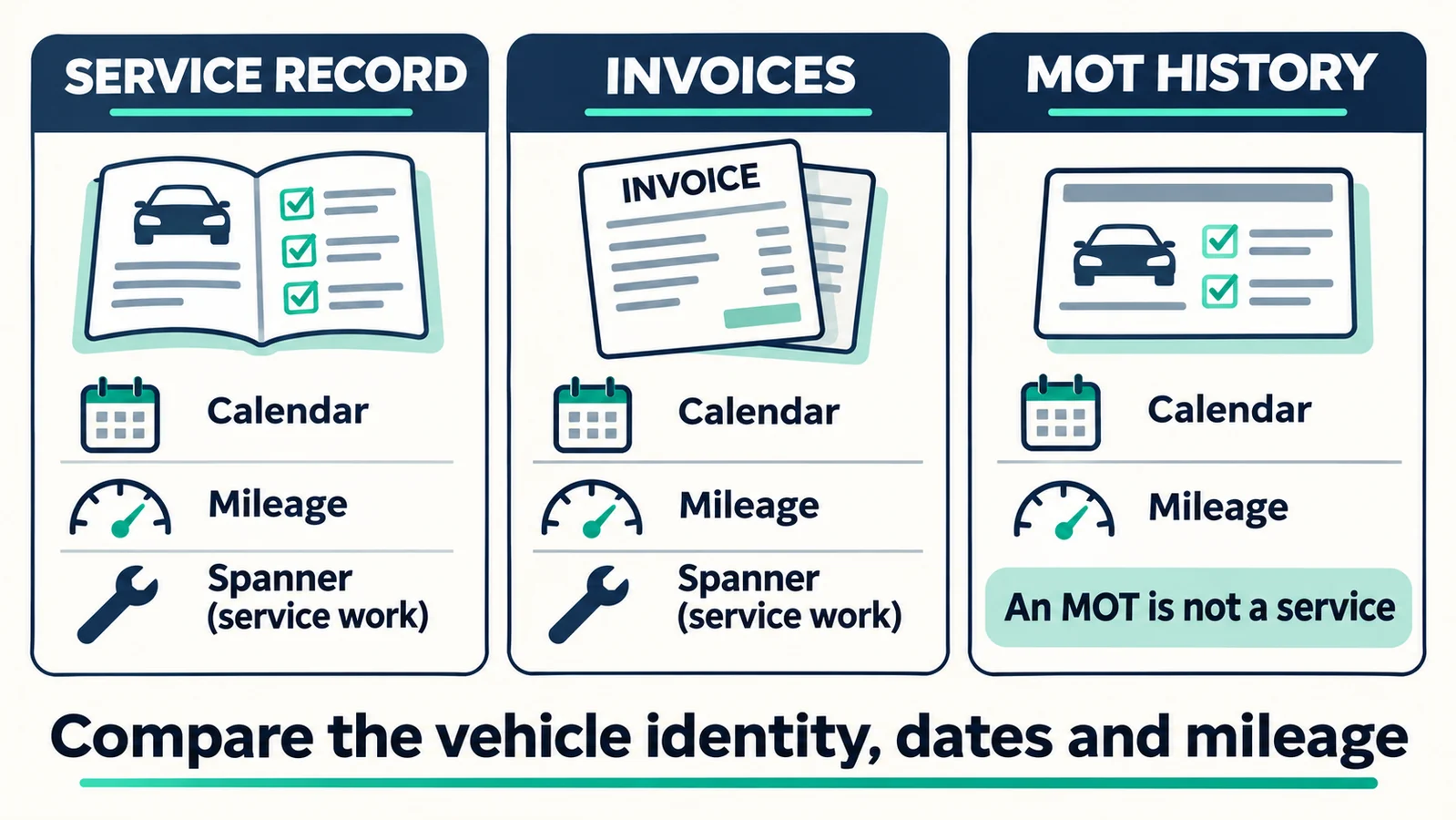
To check a used car’s service history, compare its service book, digital record and invoices against the maintenance schedule for that exact car. Match the vehicle details, dates, mileages and work recorded, then ask the issuing garage to clarify anything missing. A recent service or an uninterrupted run of MOT passes does not establish that earlier scheduled maintenance was completed.
Start before agreeing to buy. You want to establish what is documented, what the seller can recover and what remains unknown. This guide covers the paperwork; use our used-car viewing checklist for the wider inspection.
What does “full service history” actually tell you?
Treat the phrase as a claim to check, rather than a substitute for records. Ask the seller to explain which services they mean and show evidence covering the car’s life so far. A folder containing several invoices can still leave an important interval or scheduled replacement unaccounted for.
- Full service history: ask whether the evidence covers every service required for this vehicle, at the appropriate time or mileage, including applicable additional work.
- Full main-dealer service history: ask for records showing that the claimed services were completed within the manufacturer’s authorised network. A final dealer stamp does not establish where earlier work happened.
- Part service history: find out exactly which periods or jobs lack evidence. Two cars described this way can have very different gaps.
- Recently serviced: establish what was done on that occasion. It does not answer the question about previous years.
These are questions for assessing the description, not a legal definition or a guarantee of condition. Judge independent-garage records by their identifiable vehicle details and documented work, rather than dismissing them because they lack a manufacturer logo.
Ask for these records before the viewing
Request clear copies of the service-book pages, the latest digital service-history printout and itemised invoices or completed check sheets. Ask whether any records are held by a previous servicing garage, a leasing provider or the manufacturer’s network. The seller should arrange access through the relevant record holder.
For a digital history, ask the seller to show the record for this car and obtain a copy you can keep if you buy. You do not need their app password or access to their personal account. Request vehicle and work details with unrelated customer information removed, rather than insisting on previous owners’ addresses or payment details.
| Record | What to inspect | What still needs checking |
|---|---|---|
| Paper service book | Vehicle identity, dates, mileages, garage details and the boxes completed. | A stamp alone may not identify every operation or additional replacement. |
| Digital service record | The vehicle selected, recorded visits, work descriptions and issuing system. | Which garages and types of work the system includes; missing entries need investigation. |
| Itemised invoice or completed check sheet | Vehicle reference, date, mileage, parts and operations actually charged for or marked completed. | Whether it is a completed job rather than a quote, and whether ambiguous descriptions can be clarified. |
| Receipt for parts | What was bought and when. | Purchase alone does not establish that a part was fitted to this car. |
| MOT history | Test dates, recorded mileages and results. | Routine servicing and scheduled replacements require separate evidence. |
The official MOT history service supplies test results and recorded mileage; it is a cross-check alongside the maintenance paperwork. [1]
Match the paperwork to the car
At the viewing, compare the vehicle identification number (VIN) on the car with its V5C registration certificate. GOV.UK’s used-car checks also advise matching the vehicle details with DVLA’s information and checking the MOT history. [2]
Then check the vehicle references on the service documents. An invoice may use the registration number, the VIN or both. If an older invoice has a different registration, ask the seller and record issuer to establish that it belongs to this car; do not assume either that it is fraudulent or that it must be correct. A matching model name alone is not enough.
For anything significant, use contact details found independently through the garage’s own published website or the manufacturer’s dealer directory. Give the issuer the invoice or service reference and ask what it can confirm. If it needs the customer’s authority, ask the seller to arrange that. A refusal to release someone else’s personal information does not prove that the service never happened.
Build a date-and-mileage timeline
Put the evidence in date order, keeping MOT entries distinct from services. For each maintenance visit, note the mileage, recorded work and document supporting it. This makes an unexplained gap easier to see than a pile of receipts does.
Use a simple worksheet with five columns: date, mileage, recorded work, evidence and question to resolve. Leave a question visible until there is an answer you can support with a document or confirmation from its issuer.
For example, suppose a seller provides service invoices from March 2023 and March 2025, with an MOT pass between them. That is an illustrative paperwork gap, not proof that a 2024 service was missed. First establish the applicable interval. If a service fell due, ask for its record; the MOT cannot fill that space in the timeline.
Look for duplicate entries for the same visit, invoices dated after the work, unclear mileage units and readings that do not fit the surrounding records. Ask for an explanation and, where appropriate, a correction from the issuer. Do not silently amend a number or describe an unexplained discrepancy as verified mileage.
Check the work, not just the number of stamps
Obtain the maintenance schedule for the correct model, year, engine or powertrain and market. Ask a manufacturer’s dealer or a suitable specialist to identify the schedule from the VIN if the paperwork is unclear. Avoid using a generic interval for every car wearing the same badge.
Compare each relevant requirement with the records. A visit labelled “service” does not, by itself, tell you that every separately due item was completed. If the schedule requires additional work, look for the actual operation on an invoice or check sheet and query vague descriptions.
For help understanding maintenance packages and quote wording, see what is included in a car service. Here, the question is whether the documents support what this particular car needed.
Use MOT history without mistaking it for service history
Check the official MOT record using the registration number. Compare its dated mileage readings with the service timeline and note issues you want to ask about. The GOV.UK service’s coverage differs between Great Britain and Northern Ireland, so check its guidance if an older result appears absent. [1]
A pass does not certify the car’s maintenance history. GOV.UK states that the MOT does not cover the condition of the engine, clutch or gearbox. In particular, an MOT certificate does not establish when an oil change or scheduled component replacement happened. [4]
Keep the questions separate: “Did the car pass that test?”, “What maintenance is documented?” and “What condition is it in now?” A strong answer to one does not settle the others.
How to recover missing digital or paper records
- Ask the seller to identify the servicing businesses. Start with the garage named in the book, an invoice reference or an existing digital entry.
- Request a duplicate from the original record holder. Ask what vehicle identification and customer authority it needs. Do not assume every old record remains available.
- Check the manufacturer’s route for this vehicle. It may involve an owner portal, an authorised dealer or both. Confirm access and coverage rather than assuming every brand works alike.
- Keep recovered records with their source. Note whether the evidence is a replacement invoice, an issuer’s confirmation or a service-history printout. A newly stamped blank book without supporting records does not resolve the same questions.
Toyota UK directs owners to the MyToyota app or a Toyota dealer for service history, and to a dealer for help with a lost Service and Warranty booklet. Ask the seller to obtain the relevant record before buying. [3]
The MyToyota Customer Portal automatically tracks services performed by a Toyota dealer, according to Toyota’s Help Centre. If the seller says work happened elsewhere, ask for those records too; that portal description does not establish that every independent-garage visit will appear. [5]
Before paying a third party for a history search, read exactly which records it says it can supply and what happens if no relevant entry is found. Do not assume that a general vehicle-history report includes complete servicing evidence. Judge any supplied maintenance entry using the same identity, date, mileage and work checks.
What to do when the record is incomplete
The book is missing, but invoices or a digital record survive
Reconstruct the timeline from those records and check the work against the correct schedule. A missing booklet and missing maintenance evidence are different problems. Ask for issuer confirmation where details are ambiguous.
The seller confirms a service was late or missed
Record that accurately. A service carried out now cannot establish what happened during the earlier gap. Ask an appropriately qualified garage about the implications for this exact vehicle and obtain a written scope and quote for any proposed work before deciding.
The seller says it was serviced, but cannot produce evidence
Describe that period as unverified. It is neither proof of neglect nor a documented service. Decide whether the uncertainty is acceptable only after assessing the car and the maintenance that can be established. An inspection can assess present condition within its scope; it cannot reconstruct every past oil change.
The vehicle details or mileages remain contradictory
Pause the purchase while the seller and record issuer resolve them. If the explanation cannot be supported, choosing another car is a reasonable outcome. You do not need to prove fraud to decide that the evidence is insufficient.
Before you agree to buy
- Can you connect the service evidence to this specific vehicle?
- Have you compared dates, mileages and recorded jobs with the applicable maintenance requirements?
- Are missing periods and uncertain work clearly identified, rather than hidden by the phrase “full history”?
- Have important discrepancies been clarified by the issuer where possible?
- Do you understand what maintenance is next due and have a suitable garage assess unresolved technical concerns?
- Will you receive the agreed records, including digital printouts, when the car changes hands?
Retain the advert and the seller’s written description alongside the documents provided. If a particular claim matters to your decision, ask for it to be specific: which work, at what mileage, on which date, and supported by which record.
Sources
- GOV.UK — Check the MOT history of a vehicle. Test-history contents and coverage. Checked 6 November 2026.
- GOV.UK — Check a used vehicle you’re buying. Vehicle, V5C and VIN checks. Checked 6 November 2026.
- Toyota UK — Service, MOT and Maintenance. Service-history access and lost-booklet guidance. Checked 6 November 2026.
- GOV.UK — How the MOT test works. Scope of the MOT. Checked 6 November 2026.
- Toyota UK — Help Centre. “How do I find my car’s service history?” Checked 6 November 2026.