Choose the Ford Fiesta if a compact car suits your passengers and luggage, especially where parking length matters. Start with the Ford Focus if you regularly carry adults in the back or need more usable load space. For a used purchase, that recommendation is conditional: a well-documented Fiesta that fits your life is preferable to a neglected Focus bought for its extra room.
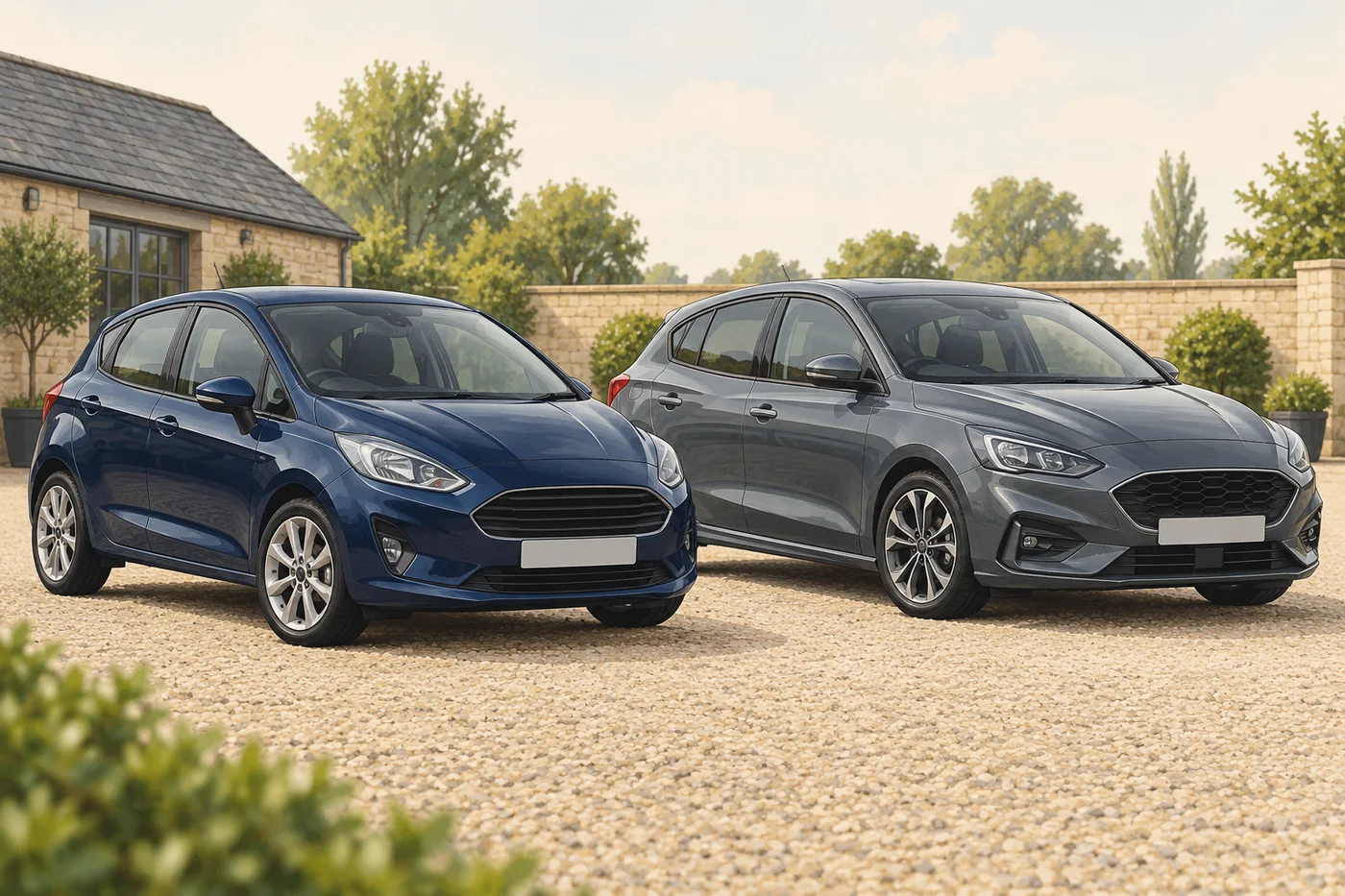
This guide compares facelift five-door hatchbacks from the Fiesta generation introduced in 2017 and the fourth-generation Focus introduced in 2018. The specifications come from the January 2022 Fiesta brochure (MY 2022.25) and November 2022 Focus brochure (MY 2023.25), so they are not a matched model-year specification. It is aimed at UK used-car buyers, with the wider 2017–2023 Fiesta and 2018-on Focus ranges kept in context. Earlier versions, three-door Fiestas, Focus Estates and ST performance models need their own checks. Registration year alone does not establish the build specification. This is a document-based buying comparison; we have not road-tested these cars.
How much bigger is the Focus?
| Measurement | Fiesta | Focus |
|---|---|---|
| Length | 4,048mm | 4,382mm |
| Body width, excluding mirrors | 1,735mm | 1,825mm |
| Width, mirrors extended | 1,941mm | 1,979mm |
| Width, mirrors folded | 1,783mm | 1,848mm |
These figures come from Ford’s January 2022 UK Fiesta brochure, page 29, archived by a Ford dealer and November 2022 UK Focus MY 2023.25 brochure, dimensions section. Active, ST-Line and ST bodywork changes some measurements.
The Focus is 334mm longer, but only 38mm wider across its extended mirrors in this comparison. That matters when deciding whether the Fiesta solves a narrow entrance: the benefit is much smaller than the body-width figures suggest. Measure your opening and allow working clearance; neither published width tells you whether a door opens far enough beside a wall.
Rear seats and boot: test the load you actually carry
The Focus is the stronger starting point for regular rear-seat use, but your seating arrangement decides the result. Set the driver’s seat properly before checking the space behind it. A showroom demonstration with the front seat pushed forward proves little for a tall driver.
Do the same with your child seats. Confirm compatibility and installation against both manufacturers’ instructions, then check access to the buckles and whether the front passenger can sit comfortably. A five-seat designation is not evidence that three particular child seats fit across the rear bench.
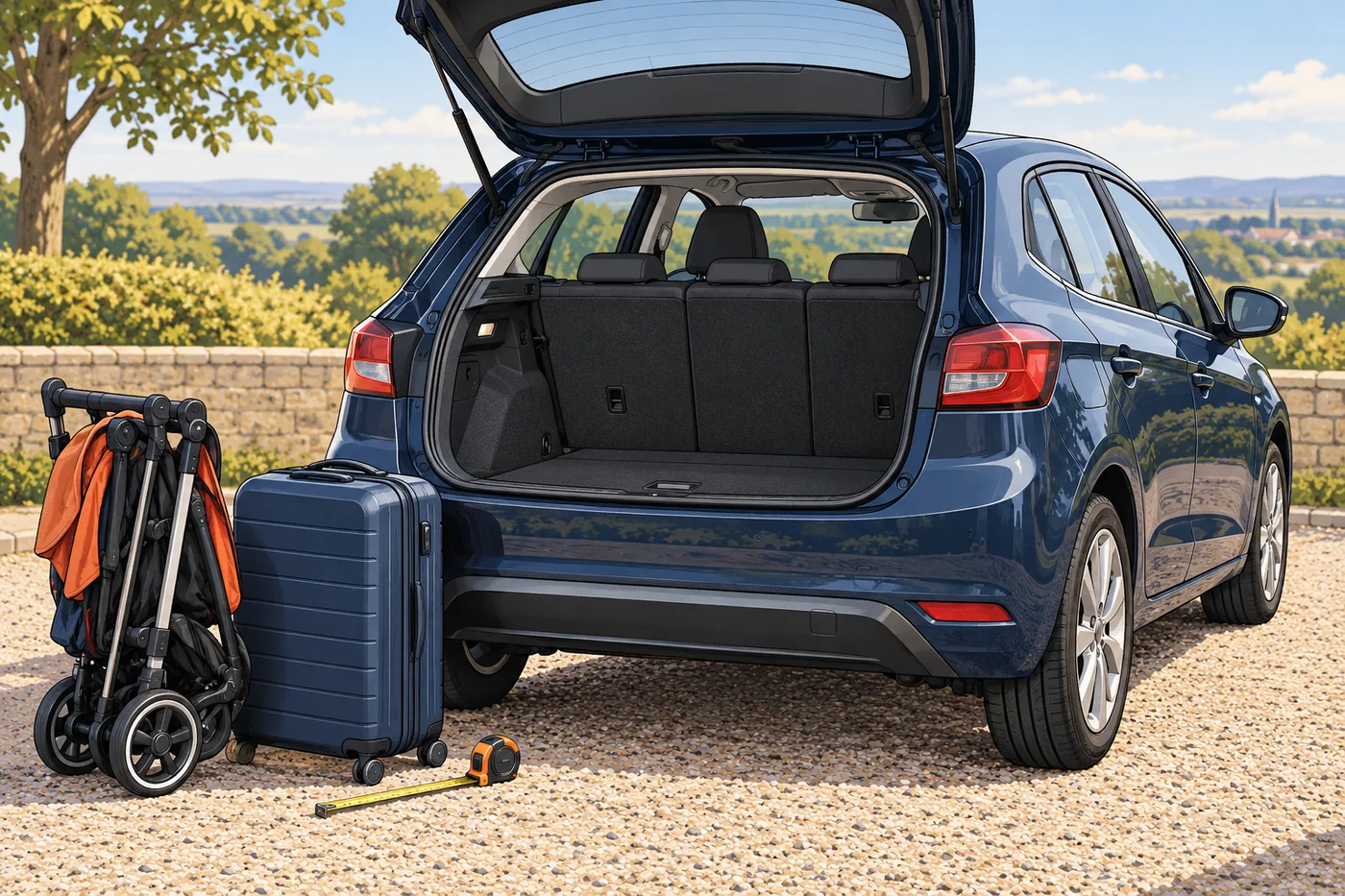
Boot litres need similar care. Ford’s Focus brochure lists different capacities with a mini spare wheel and with a mini spare plus B&O audio equipment. Consequently, one headline capacity cannot describe every used Focus. Check the actual boot floor, spare-wheel provision and equipment before comparing it with a Fiesta.
- Bring your largest regular item. Try the pushchair, mobility aid, dog crate or work case with all required passenger seats upright.
- Check the opening and lifting height. A load that fits inside may still be awkward to pass through the tailgate.
- Add the everyday bags. Leave room for the shopping or school kit that travels alongside the bulky item.
- Close the tailgate gently. Check that the load and luggage cover do not interfere, then practise lifting the item out.
If the hatchback fails this test, inspect a Focus Estate separately. Its longer body and different load area make it a distinct purchase, not a higher trim level of the hatchback. Measure the parking space again before assuming the Estate is the answer.
Choose the engine and gearbox before the trim
Write down the exact engine, power output, transmission and build details from each advert. “1.0 EcoBoost” alone is not enough to establish identical specification or maintenance requirements. Likewise, do not treat every automatic bearing a familiar gearbox name as the same unit across generations.
EcoBoost Hybrid versions use mild-hybrid assistance. They cannot be plugged in and do not provide electric-only driving, as Ford’s mild-hybrid explanation confirms. Buy one for the whole vehicle’s suitability, not the expectation of an electric school run.
If an automatic is essential, compare two automatics before weighing price or fuel consumption. During an insured test drive, assess pulling away, reversing and stop-start traffic once the car is warm. Unexpected judder, warning messages or reluctance to engage a gear call for diagnosis; do not accept “they all do that” without evidence. Our manual-versus-automatic guide helps separate convenience from ownership considerations.
ST-Line is a trim with sporty styling and version-dependent suspension changes; it is separate from the ST performance model. Active versions also have different suspension and body specifications. Choose the individual seats, wheels and controls you like using, rather than assuming a higher trim suits you better.
Which is more reliable, and what about EcoBoost belts?
There is no defensible single reliability winner from the badges alone. These names cover different engines, gearboxes, ages and maintenance histories. We have not assigned failure rates or an unsupported reliability score.
Before paying a deposit, ask for the vehicle-specific maintenance schedule and compare it with dated invoices. Ford says service intervals vary by model and engine; oil-change requirements can also depend on use. A stamped book without supporting detail leaves more questions than invoices identifying the work and materials.
For an EcoBoost, ask a Ford dealer or suitably qualified specialist to identify the timing-drive and oil-pump-drive arrangements for that engine and confirm the applicable inspection or replacement requirements. Do not apply an internet “wet belt interval” to every Fiesta or Focus. Obtain written evidence of any claimed belt work, including its scope, rather than treating “belt done” as a complete service record.
Oil invoices should show the required Ford specification, not just a viscosity such as 5W-30. Use the Ford handbook lookup by VIN or model year and our engine-oil specification guide. Missing records, unexplained fluid loss or warning lights warrant an independent inspection before purchase.
Compare the first year’s costs, not just the asking prices
A Fiesta is not automatically cheaper to own than every Focus. Obtain insurance quotes for the actual registrations and written estimates for the next scheduled service, tyres and any overdue work. Compare adverts with similar age, mileage, engine, gearbox and history; otherwise a cheaper car may simply have an expensive job approaching.
Make one budget for each candidate: purchase price, insurance, applicable vehicle tax, expected fuel spend, scheduled maintenance and identified repairs. Keep a separate allowance for unforeseen work. If comparing finance, record the total payable and any final payment as well as the monthly amount.
Use fuel figures tested under the same procedure as a comparison aid, not a promise. Avoid deriving a claimed annual saving from one seller’s trip-computer photograph. A longer motorway commute and repeated short trips are different use cases; your own mileage and route belong in the budget.
Checks to complete on either car
- Match the identity. Check the VIN, V5C and advertised model details; use the GOV.UK used-vehicle checks.
- Read the history. Review mileage progression, failures and advisories in the MOT record, then ask for evidence that relevant faults were repaired.
- Check recalls. Use the official recall service and confirm outstanding actions with Ford. Follow any instruction not to drive.
- Try the equipment. Connect your phone while parked; operate the air conditioning, windows, locks, lights and parking aids. Confirm the supplied keys and handbook.
- Inspect before committing. Arrange an independent mechanical inspection where records or condition leave uncertainty. A short test drive does not establish engine health.
Take our car-viewing checklist and questions for a used-car seller to keep the two appointments comparable.
Which should be on your shortlist?
Mostly one or two people, with difficult parking
Try the Fiesta first. Confirm its actual luggage capacity and door clearance, then decide whether the Focus offers space you would use often enough to justify its extra length and any cost difference.
Regular adult passengers or a bulky family load
Try the Focus first, using your real seating positions and luggage. If it fails, investigate an Estate or a different car rather than forcing an unsuitable hatchback into the role.
A newer Fiesta versus an older Focus at the same price
Compare documented condition and upcoming work before choosing by age. Reject any car that fails an essential space or history check. Among the remaining candidates, favour the one with evidence you can verify and costs you can afford.