Start with the Ford Galaxy if you need seven seats regularly and want to make the most of the cabin’s height and luggage space. Try the Ford S-MAX if its lower body appeals and your passengers fit comfortably. The S-MAX is not a narrow alternative: the two have the same published mirror width in the specification compared here. Buy the car that passes your passenger, luggage and maintenance checks, rather than choosing from the badge alone.
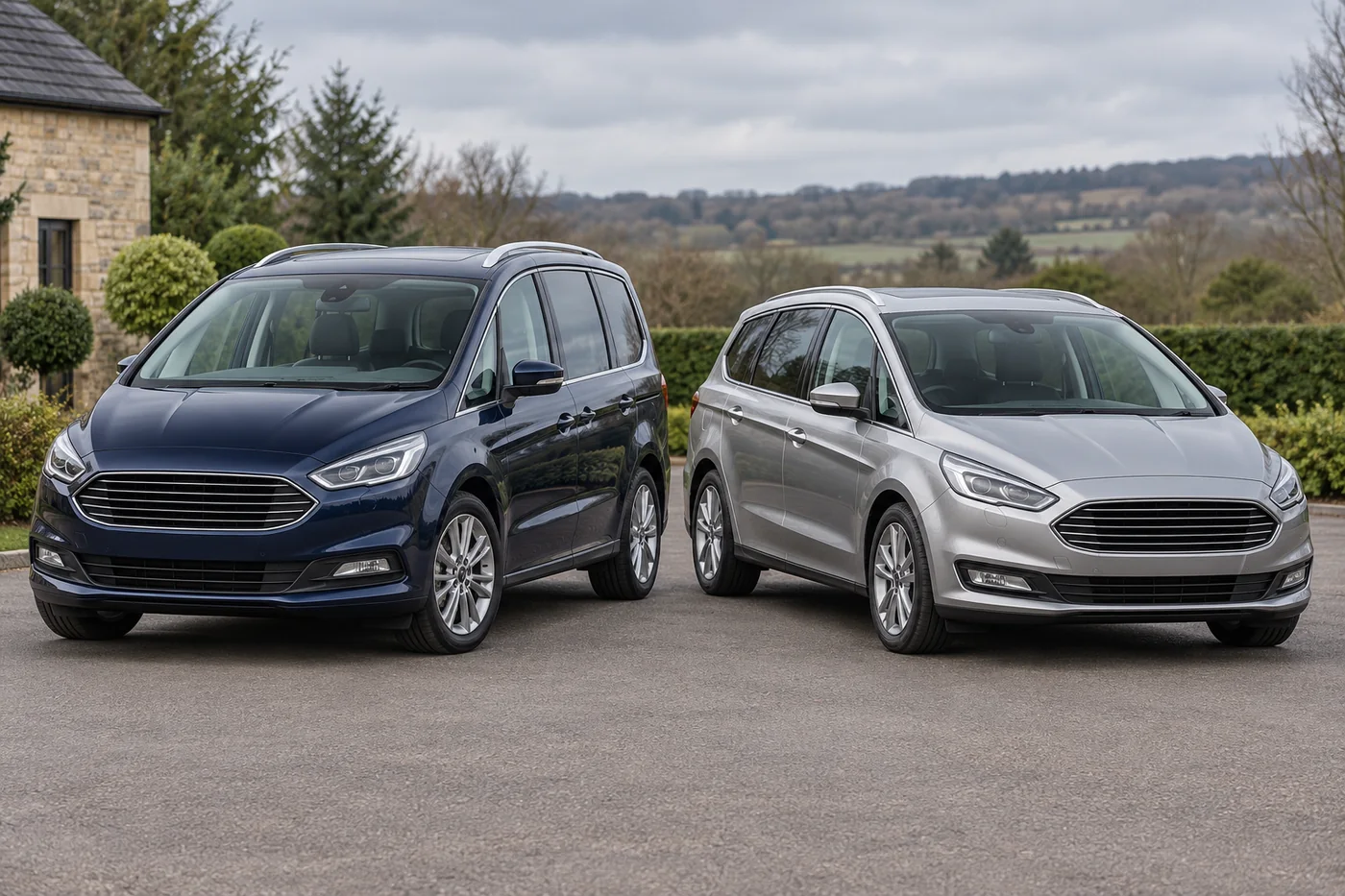
This guide is for UK used-car buyers considering the Galaxy and S-MAX generations introduced in 2015. Its specification comparison uses Ford’s UK MY 2021.5 brochures, including the later diesel and full-hybrid range. It does not apply those specifications to earlier 2006-generation cars or every 2015-on version. Build date, engine, gearbox and equipment still need checking. This is a document-based comparison; we have not road-tested either car.
How much bigger is a Galaxy than an S-MAX?
| Measurement | Galaxy | S-MAX |
|---|---|---|
| Length, without towbar | 4,853mm | 4,804mm |
| Body width, without mirrors | 1,916mm | 1,916mm |
| Width, mirrors extended | 2,137mm | 2,137mm |
| Width, mirrors folded | 1,953mm | 1,953mm |
| Unladen height | 1,770mm | 1,684mm |
Sources: Ford Galaxy MY 2021.5 brochure, dimensions section and Ford S-MAX MY 2021.5 brochure, dimensions section. The same pages contain drawings labelled with different length and height figures. We use the numerical tables above, not a mixture of the tables and drawings. Ford notes that specification and equipment can affect dimensions; confirm the individual car if a garage or height barrier leaves little clearance.
On these figures, the Galaxy is only 49mm longer but 86mm taller. The shared width is the more important finding for a narrow driveway. A lower roofline does not give the S-MAX extra room between its mirrors and your gateposts.
Measure the parking space, then check it with the exact car where possible. Include room to open a rear door, lift the tailgate and walk past with shopping. Folding mirrors can help while parked, but a brochure width is not a recommendation to drive through a gap with inadequate visibility or clearance.
Seven seats: test the people, not just the seating plan
The Galaxy is the stronger starting point when the third row is part of everyday life. Its taller body is a reason to inspect it first, not proof that every adult will find it comfortable. A child’s needs will also change during the years you own the car.
Run the same passenger test in both vehicles:
- Set the front seats for the usual drivers. Do not make the rear cabin look larger by moving the front seats out of their normal positions.
- Settle the middle row before trying the back. Check whether one passenger gains legroom only by taking too much from another.
- Ask the third-row passengers to get in and out. Check headroom, knee space, foot space and whether they can manage the access route comfortably.
- Try your child seats and everyday bags. Follow the vehicle and child-seat manufacturers’ compatibility and fitting instructions. A seven-seat badge does not guarantee that your particular combination fits.
Also operate every seat adjustment and folding mechanism while the vehicle is stationary. Look for missing head restraints, damaged buckles, trapped trim and a seat that fails to latch. Have faults assessed before using the seat; a seller’s demonstration that it folds is not enough to establish that it locks correctly.
Boot space: why the headline litres can mislead
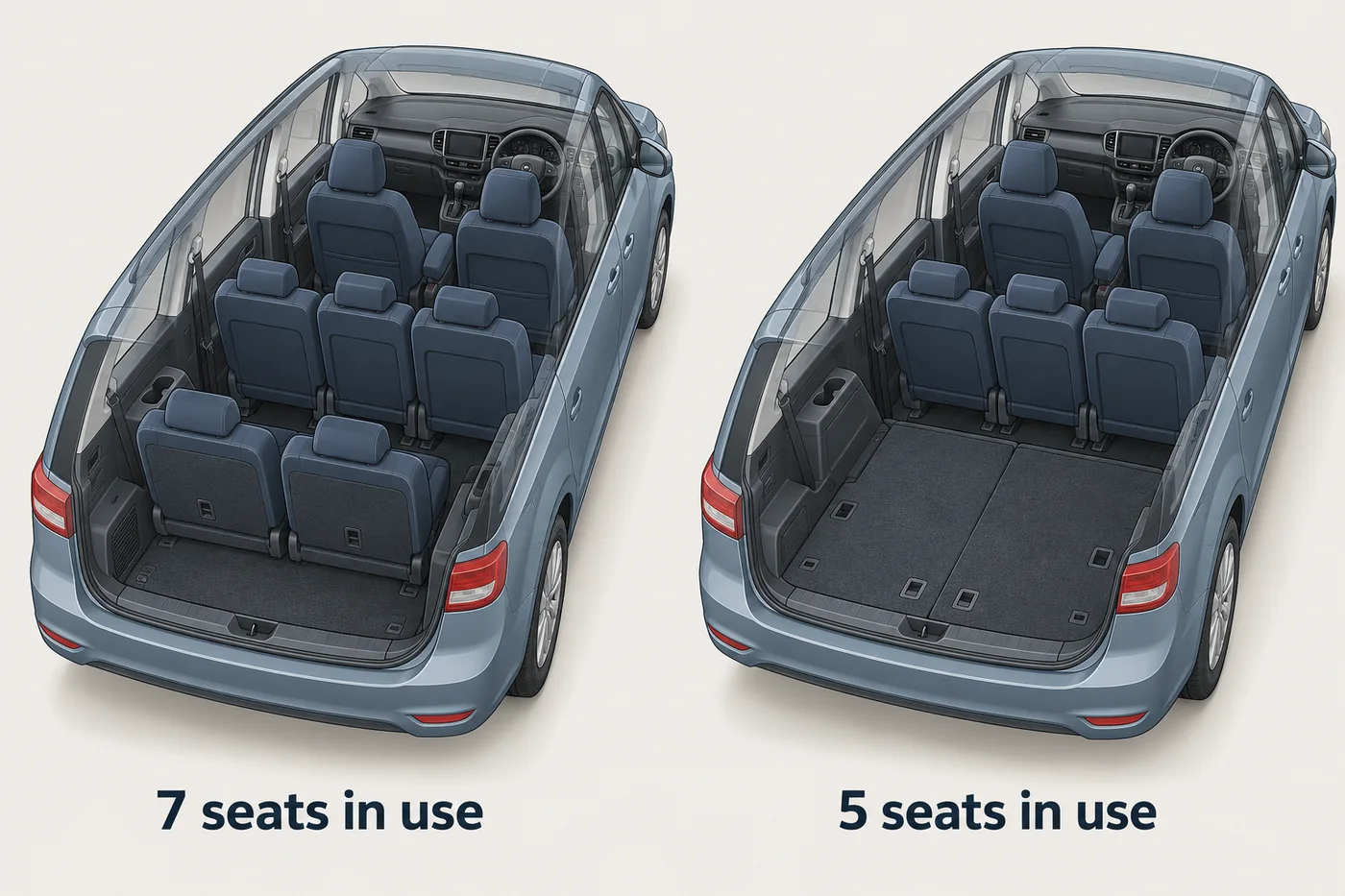
| Seats in use | Galaxy | S-MAX |
|---|---|---|
| Seven | 300 litres, to the top of the seat | 285 litres, to the roof |
| Five | 1,206 / 1,301 litres, nominal / maximum, to the roof | 965 litres, to the roof |
| Two | 2,339 litres, to the roof | 2,020 litres, to the roof |
These are the luggage entries in the two Ford brochures linked above. The seven-seat measurements use different height limits, so subtracting them does not establish that the Galaxy has precisely 15 litres more usable space. The five-seat Galaxy entry also distinguishes nominal and maximum capacity. Keep the seat positions and measuring method attached to any number you compare.
For a family holiday, the useful question is whether the pushchair and everyone’s bags fit with all the required seats upright. Bring those items to the viewing. Check the opening, the floor shape and how you will secure the load. A roof-height capacity is a measurement convention, not an instruction to stack unsecured bags behind passengers.
If neither car carries your seven-person holiday load comfortably, do not solve the problem by assuming that a roof box or trailer is automatically suitable. Check the vehicle’s load limits, accessory limits and required equipment first. Passengers and luggage both count towards the permitted load.
Diesel or hybrid, and which automatic?
The MY 2021.5 UK specification tables include 2.0-litre EcoBlue diesels and a 2.5-litre petrol full hybrid, with transmission choices depending on the version. Do not treat the description “automatic S-MAX” or “automatic Galaxy” as a complete specification. Record the engine, power output, transmission, drive layout and build date for each advert.
The later full hybrids do not plug into an external charger. Their petrol engine and regenerative braking replenish the battery, and electric-only running is available for short periods when conditions allow. This is explained in Ford’s February 2021 hybrid launch announcement; that source is used here for the shared powertrain’s operation, not Danish prices or equipment. Do not buy one expecting a plug-in hybrid’s charged electric journey.
For diesel candidates, consider how the car will actually be used rather than choosing from an annual-mileage rule alone. Our petrol-versus-diesel guide explains the driving-pattern questions. For automatics, our gearbox-types guide helps distinguish different systems; it does not determine the maintenance needs of an individual Ford.
During a properly insured test drive, assess pulling away, reversing, low-speed traffic and the response at ordinary road speeds. Unexplained warning messages, judder or delayed engagement need investigation, not reassurance based on the model’s reputation. We have not ranked the gearboxes by failure rate.
Which costs less to own?
There is no reliable answer without two actual cars. A cheaper purchase can have overdue maintenance, worn tyres or missing equipment that you need. Compare similar age, engine, gearbox, mileage and history before treating an asking-price difference as a saving.
For each shortlist entry, write down:
- The purchase price and any finance total payable, including a final payment.
- An insurance quote and vehicle-tax check for that registration.
- The next scheduled service, any overdue work and written repair estimates.
- The fitted tyre size and the replacement cost for suitable tyres.
- Your expected annual mileage and fuel budget, allowing for your journeys and passenger load.
Use official fuel figures only when they follow the same test procedure. An earlier NEDC figure and a later WLTP figure are not a fair comparison, and neither is a guarantee of your consumption. There is no price table here because we have not collected a matched, dated sample of current UK sale prices.
Service history, recalls and towing checks
Ford’s service guidance says intervals vary by model and engine. Ask for the schedule for the actual vehicle and compare it with invoices, including the required oil specification and any timing-drive work. Do not apply one internet belt interval to every diesel or petrol engine under these badges.
Check the gearbox separately. Ford directs owners to a vehicle-specific transmission maintenance schedule. Ask the seller to show the corresponding work, rather than accepting “fully serviced” as proof that every required transmission task was completed.
Use the official used-vehicle checks to match the identity and paperwork, then inspect the MOT history and recall status. Ask for evidence that relevant faults were resolved. An MOT pass does not replace an independent inspection of a car with unexplained symptoms or gaps in its records.
If you tow, obtain the limits for the exact engine, gearbox and seat configuration before making an offer. Do not borrow a headline maximum from another Galaxy or S-MAX. GOV.UK explains where to find the towing and gross train weight limits; the loaded car and loaded trailer must remain within the applicable limits.
Choose the viewing that answers your biggest concern
We use six or seven seats most days
View the Galaxy first, with the people who will use the back row. Bring the normal luggage as well. If access, seating comfort or load space fails the test, the larger published capacity is not a reason to compromise.
We usually carry five people and only occasionally need seven
Try both with the third row folded and then raised. If the S-MAX passes both situations, decide whether you prefer its seating position, controls and ride on an appropriate test route. Do not pay for extra Galaxy space you will not use unless it brings another benefit you value.
Our driveway is narrow, or the cheaper car has patchy history
Neither badge solves these problems. Their published mirror widths are the same in this comparison. Measure the exact car and parking space, and resolve the history gaps with documentary evidence and an independent inspection. Reject a candidate that fails an essential requirement.
Take the used-car viewing checklist to both appointments and record the same observations. That gives you a comparison of two cars you can buy, rather than two idealised models.